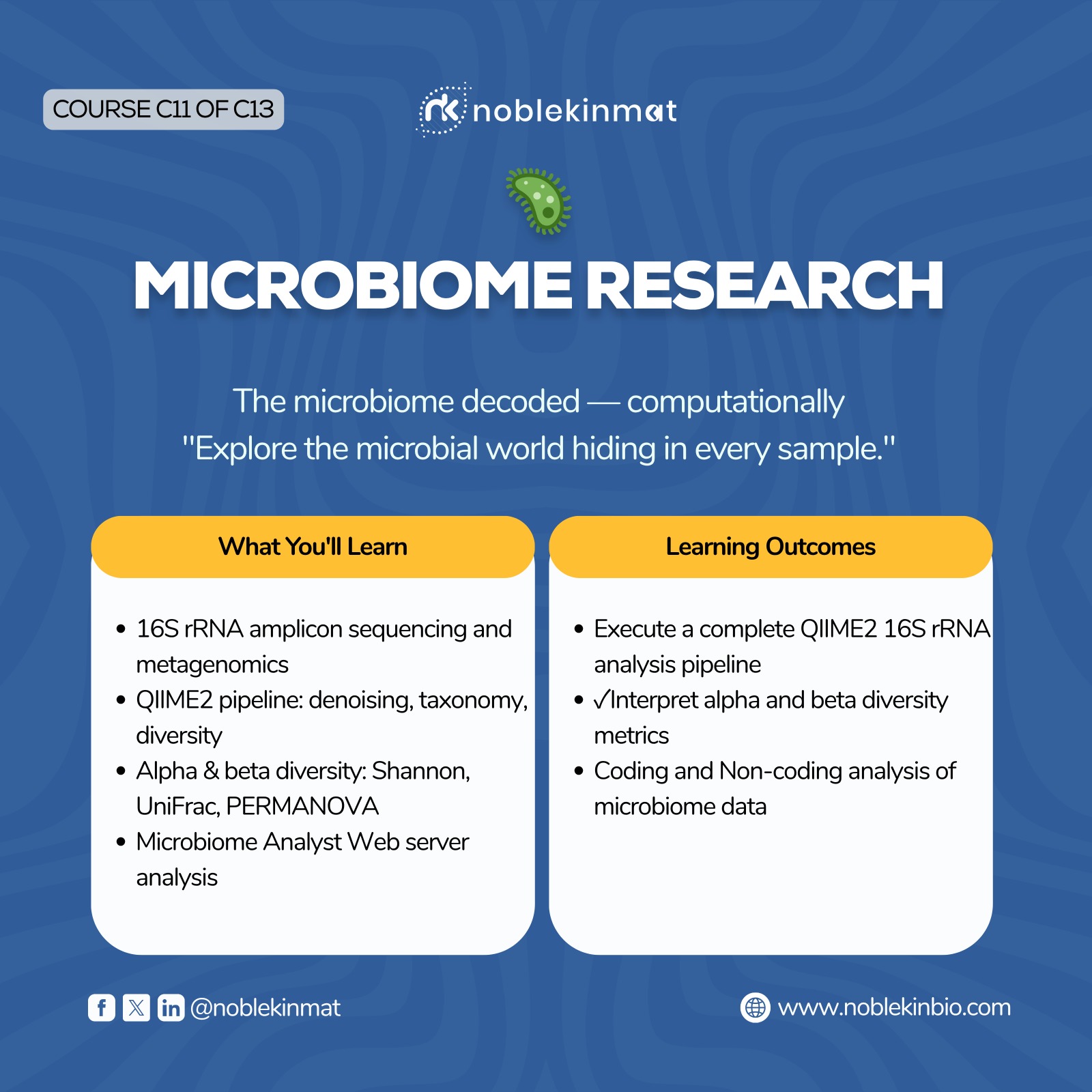
Microbiome Research
Course Overview
This course provides comprehensive training in the rapidly evolving field of microbiome research. Students learn the biological foundations of host-microbiome interactions and gain hands-on proficiency with the most widely used microbiome analysis tools — from 16S rRNA amplicon sequencing to shotgun metagenomics.
Learning Outcomes
1. Explain the principles of 16S rRNA amplicon sequencing and shotgun metagenomics.
2. Execute a complete QIIME2 pipeline from raw FASTQ to diversity analysis and differential abundance.
3. Perform taxonomic profiling using Metaphlan4 and functional profiling using HUMAnN3.
4. Perform alpha and beta diversity analysis and visualise results using phyloseq in R.
Curriculum Content
Week 1: Microbiome Biology & Methods
• Microbiome definitions: microbiota, microbiome, metagenome; human body sites (gut, oral, skin, vaginal).
• Applications: gut microbiome-disease associations (IBD, obesity, cancer, neurological disorders); agriculture (soil microbiome, plant growth-promoting rhizobacteria); environment (ocean, soil biodiversity assessment).
• 16S rRNA sequencing: hypervariable regions (V3-V4 most common), primer selection, amplicon sequencing workflow.
• Shotgun metagenomics: taxonomic + functional profiling; greater resolution than 16S; high sequencing depth required.
Week 2: QIIME2 Pipeline
• QIIME2 concepts: artifacts, visualisations, plugins, provenance tracking — fully reproducible by design.
• DADA2 within QIIME2: ASV (amplicon sequence variant) denoising — superior to OTU clustering at 97% identity.
• Taxonomy classification: naive Bayes classifier trained on SILVA 138 or Greengenes2 database.
• Diversity analysis: alpha diversity (Shannon, Faith's PD, observed features), beta diversity (Bray-Curtis, UniFrac); PERMANOVA testing.
• Differential abundance: ANCOM-BC, ALDEx2 — compositional data-aware methods.
Week 3: Shotgun Metagenomics
• KRAKEN2 + Bracken: k-mer-based taxonomic classification; abundance estimation at species level.
• Metaphlan4: marker-gene-based taxonomic profiling; strain-level resolution; MetaPhlAn merged profiles.
• HUMAnN3: functional profiling — gene family abundance (UNIREF90), pathway abundance (MetaCyc); species stratification.
• Metagenome-assembled genomes (MAGs): binning with MetaBat2, dereplication with dRep, quality with CheckM.
Hands-On Practicals
🔬 Hands-On Lab: QIIME2 16S rRNA Analysis Pipeline
Step 1: Import paired-end FASTQ files into QIIME2: qiime tools import --type SampleData[PairedEndSequencesWithQuality] --input-path manifest.tsv --output-path reads.qza --input-format PairedEndFastqManifestPhred33V2
Step 2: Denoise with DADA2: qiime dada2 denoise-paired --i-demultiplexed-seqs reads.qza --p-trunc-len-f 230 --p-trunc-len-r 200 --o-table table.qza --o-representative-sequences rep-seqs.qza
Step 3: Classify taxonomy: qiime feature-classifier classify-sklearn --i-classifier silva-138-99-515-806-nb-classifier.qza --i-reads rep-seqs.qza --o-classification taxonomy.qza
Step 4: Alpha diversity: qiime diversity alpha-rarefaction --i-table table.qza --p-max-depth 10000 --o-visualization rarefaction.qzv
Step 5: Beta diversity PCoA: qiime diversity core-metrics-phylogenetic --i-table table.qza --p-sampling-depth 5000 --i-phylogeny rooted-tree.qza --m-metadata-file metadata.tsv --output-dir core-metrics/
Step 6: Export results and create phyloseq object in R for downstream analysis.