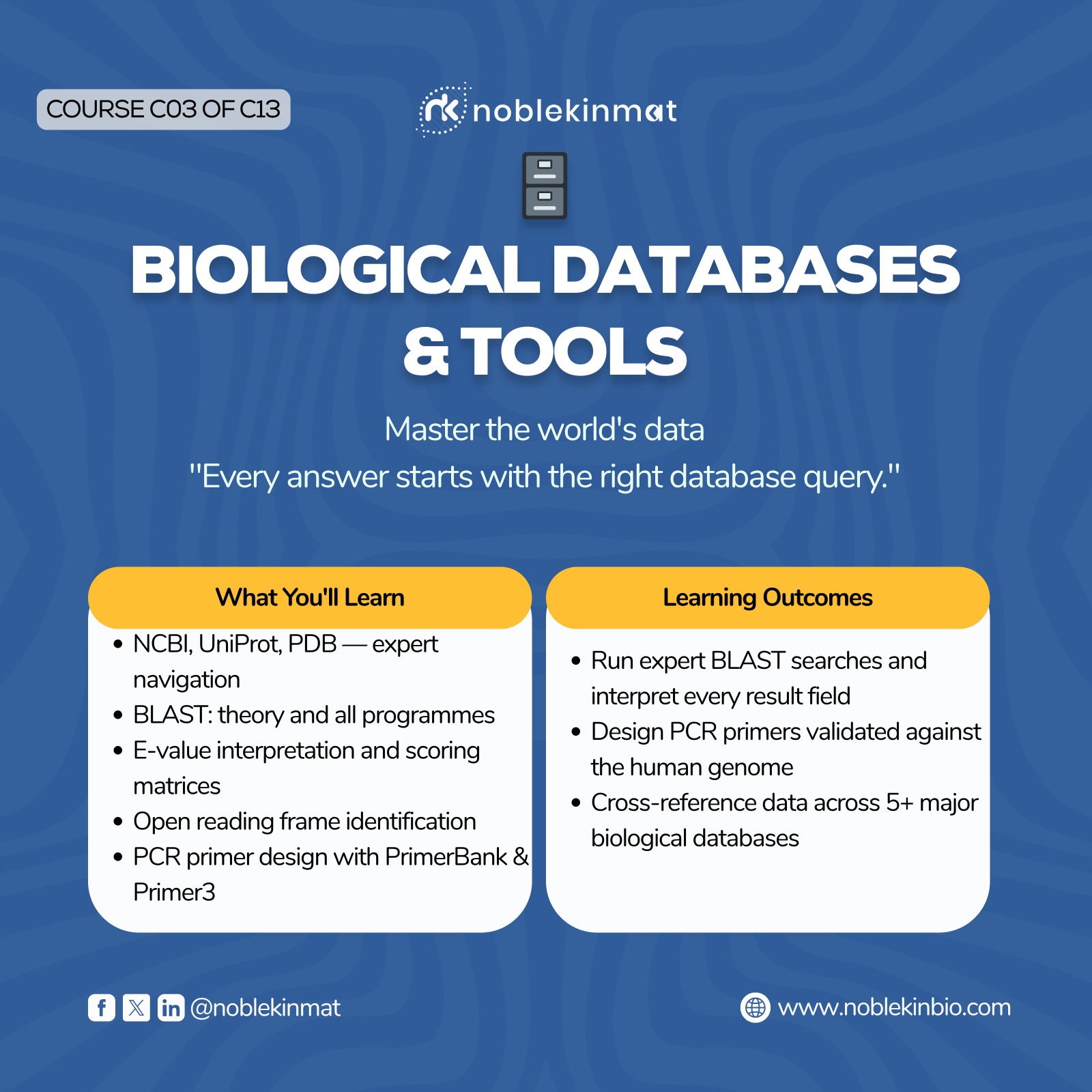
Biological Databases & Tools
Course Overview
This course provides comprehensive, hands-on training with all major biological databases and bioinformatics tools. Students gain the practical database skills that form the daily toolkit of any bioinformatics researcher. By the end, students can efficiently navigate, query, and cross-reference databases to answer real biological questions.
Learning Outcomes
1. Navigate NCBI, UniProt, and PDB databases with expert efficiency.
2. Design and execute BLAST searches appropriate for different biological questions.
3. Identify open reading frames and annotate genomic sequences.
4. Design specific, efficient PCR primers using PrimerBank and Primer3.
5. Cross-reference data across multiple databases to answer complex biological questions.
Curriculum Content
Weeks 1–2: NCBI — The World's Primary Biological Database
• NCBI architecture: GenBank (nucleotide), RefSeq (curated reference), PubMed (literature), GEO (gene expression), ClinVar (clinical variants), dbSNP (polymorphisms), SRA (raw sequencing).
• BLAST algorithm: local alignment using seed-and-extend heuristic; scoring matrix (BLOSUM62, PAM250); E-value interpretation; bit scores.
• BLAST programmes: blastn, blastp, blastx, tblastn, tblastx — use cases and sequence type requirements.
• Advanced BLAST: restricting to taxonomic group, excluding organisms, adjusting E-value threshold, using PSI-BLAST for remote homologue detection.
Week 3: UniProt & PDB
• UniProt architecture: Swiss-Prot (curated) vs. TrEMBL (automatic); protein family classification; GO term annotation.
• UniProt entry anatomy: protein name, function, subcellular location, PTMs, variants, structure links, interaction partners.
• PDB: deposition pipeline, experimental methods (X-ray, NMR, cryo-EM, AlphaFold), resolution and R-factor quality metrics.
• Cross-referencing: UniProt → PDB, UniProt → OMIM, UniProt → GO, NCBI Gene → OMIM → ClinVar.
Week 4: ORF Finding & Primer Design
• Open reading frames: definition, reading frames, Kozak consensus sequence, start codon context.
• ORF finding tools: ORFFINDER (NCBI), getorf (EMBOSS), ORF prediction in prokaryotes vs. eukaryotes.
• PCR primer design principles: Tm, GC content, primer length, self-complementarity, 3' stability, amplicon size.
• Primer design tools: PrimerBank (validated primer database for human/mouse genes), Primer3, NCBI Primer-BLAST (checks specificity by BLASTing primers against genome).
Hands-On Practicals
🔬 Hands-On Lab: Complete BLAST Workflow
Step 1: Download the protein sequence of human EGFR (UniProt P00533) in FASTA format.
Step 2: Run BLASTp against nr database, restricting to vertebrates (taxid:7742). Record top 10 hits.
Step 3: Re-run without taxonomy filter — identify the most distant homologue with E < 0.001.
Step 4: Run PSI-BLAST for 3 iterations — identify any additional distant homologues detected only by PSI-BLAST.
Step 5: Download aligned sequences and note which domain is most conserved across all species.
🔬 Hands-On Lab: PCR Primer Design for a Target Gene
Step 1: Select a gene of interest (e.g., GAPDH as housekeeping, or your own gene of interest).
Step 2: Use NCBI Primer-BLAST to design primers spanning an exon-exon junction (to exclude genomic DNA amplification).
Step 3: Verify specificity: ensure primers BLAST uniquely to your target mRNA, not to pseudogenes or off-targets.
Step 4: Cross-check with PrimerBank — find any pre-validated primer pairs for the same gene and compare Tm values.
Step 5: Write a PCR protocol using the designed primers (annealing temperature, cycle number, expected band size).