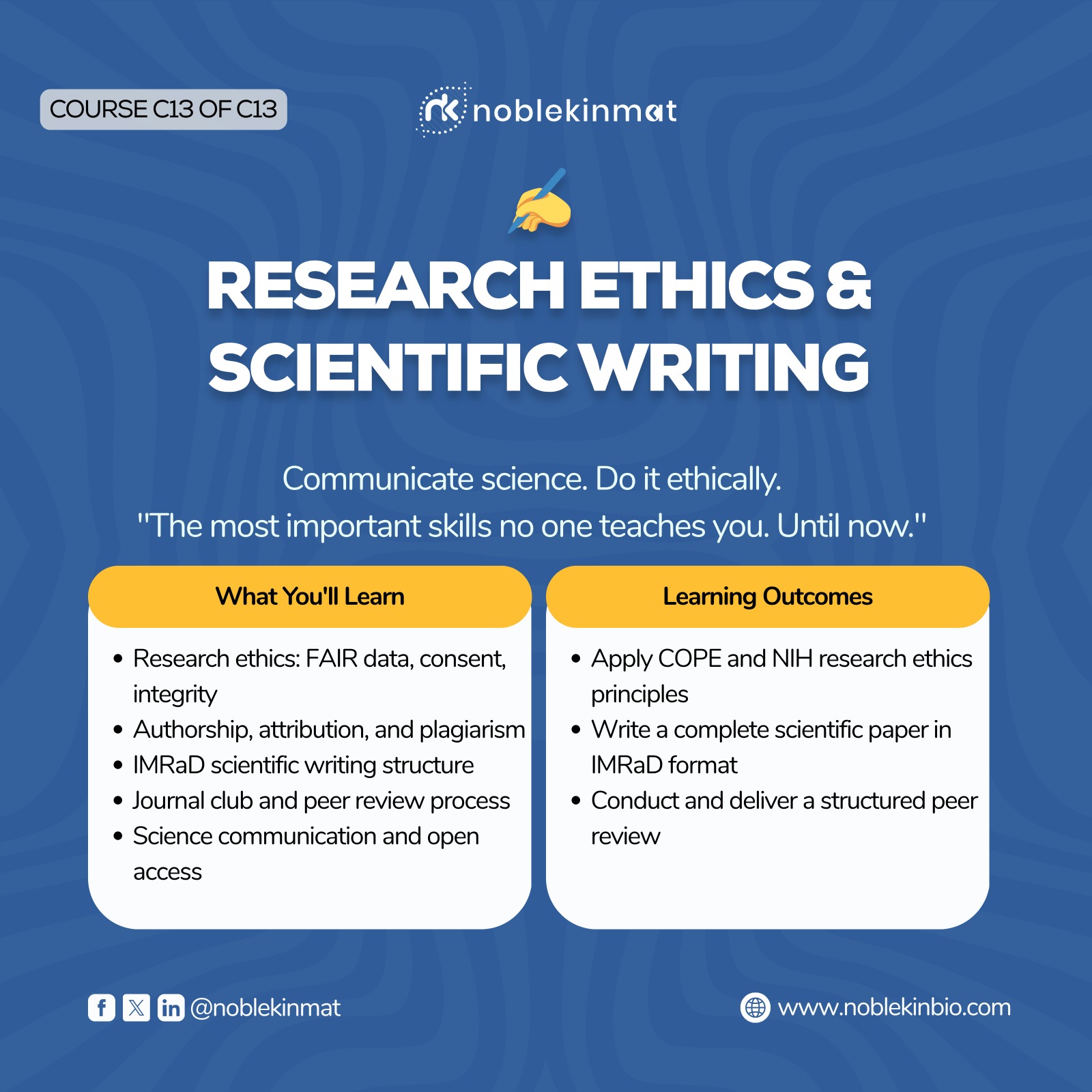
Research Ethics & Scientific Writing
Course Overview
The capstone course of the certificate program equips students with the professional skills needed to conduct ethical research and communicate findings effectively. This course follows standards set by COPE (Committee on Publication Ethics), NIH research ethics guidelines, and international science communication best practices.
Learning Outcomes
1. Apply research ethics principles to bioinformatics data use, authorship, and publication.
2. Identify and navigate common ethical challenges: data privacy, AI bias, dual-use research, reproducibility.
3. Write a structured scientific paper using the IMRaD format with clarity and precision.
4. Conduct and participate constructively in a journal club peer review session.
5. Register an ORCID iD and understand the scholarly communication ecosystem.
Curriculum Content
Week 1: Research Ethics in Life Sciences & Data Science
• Core principles: beneficence, non-maleficence, justice, respect for autonomy — Helsinki Declaration, Belmont Report.
• Data ethics in bioinformatics: consent for genomic data use, re-identification risk, data sharing (FAIR principles — Findable, Accessible, Interoperable, Reusable).
• Authorship and attribution: ICMJE criteria (conception, drafting, approval, accountability); gift authorship and ghost authorship as violations; contributor roles taxonomy (CRediT).
• Research integrity: fabrication, falsification, plagiarism (FFP); data manipulation detection; p-hacking and HARKing (Hypothesising After Results are Known).
• Responsible AI in bioinformatics: algorithmic bias in clinical predictions, transparency, explainability requirements.
• Dual-use research of concern (DURC): biosecurity considerations in pathogen sequence sharing, gain-of-function research governance.
Week 2: Scientific Writing & Communication
• IMRaD structure: Introduction (funnel from broad to specific, ends with hypothesis), Methods (reproducible, past tense), Results (objective, figure-first), Discussion (interpret, compare, acknowledge limitations).
• Writing principles: one idea per sentence, active voice where possible, verb-before-subject, avoiding jargon without definition.
• Figure design: Tufte data-to-ink ratio, colour accessibility (colourblind palettes), vector vs. raster graphics, publication specifications (300 dpi, TIFF/PDF).
• Reference management: Zotero — library organisation, citation styles (APA, Vancouver, Nature), Zotero integration with Word/Overleaf.
• The peer review process: roles of author, reviewer, editor; types of review (single-blind, double-blind, open); constructive review writing; responding to reviewers.
• Science communication: preprints (bioRxiv/medRxiv), open access, social media for science, press release writing.
Hands-On Practicals
🔬 Hands-On Lab: Journal Club — Critical Appraisal
Step 1: Each student selects a recent bioinformatics paper (past 12 months) from Nature Methods, Bioinformatics, or Genome Biology.
Step 2: Prepare a 10-minute presentation: overview (1 min), biological question (2 min), methods critique (3 min), results evaluation (3 min), limitations and future directions (1 min).
Step 3: For methods critique: are the methods reproducible? Is code available? Is the dataset publicly deposited? Were appropriate controls used?
Step 4: For results evaluation: are the figures clear? Are statistical tests appropriate? Does the data support the conclusions?
Step 5: Write a 400-word structured peer review in the format of a journal response.
🔬 Hands-On Lab: IMRaD Writing Workshop
Step 1: Take the results from any practical completed in courses C01–C12 (e.g., your DESeq2 analysis, docking results, or QIIME2 diversity analysis).
Step 2: Write a complete mini-paper using the IMRaD format: Introduction (250 words), Methods (350 words), Results (300 words + at least 2 figures), Discussion (250 words).
Step 3: Identify and cite 8 references using Zotero — mix of primary research and review articles.
Step 4: Exchange paper with a peer and write a 500-word peer review report: major concerns, minor concerns, and one specific suggestion for improvement.
Step 5: Revise your paper based on peer feedback and write a 200-word response to reviewers letter.