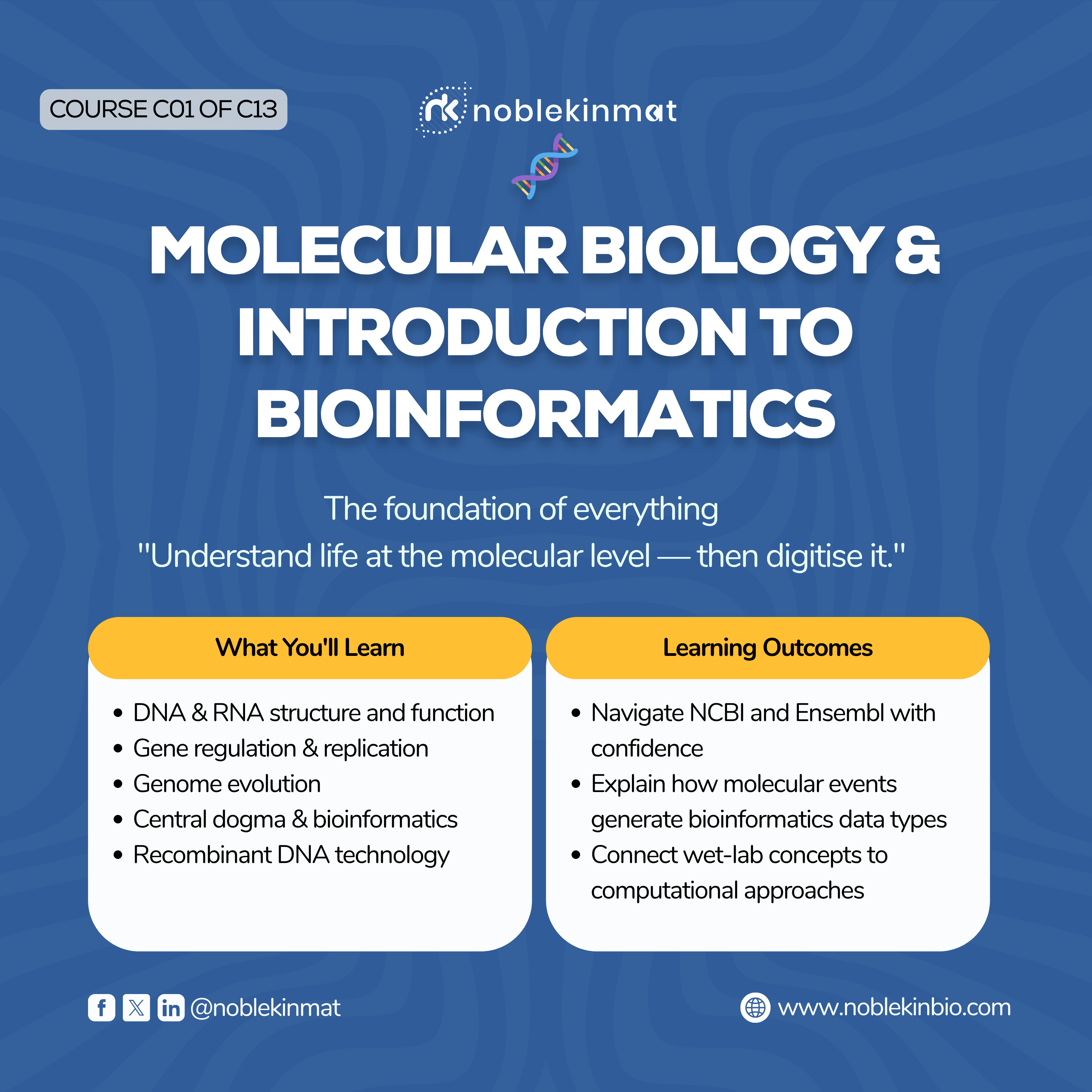
Molecular Biology & Introduction to Bioinformatics
Course Overview
This foundational course establishes the biological and computational knowledge required for all subsequent bioinformatics courses. Students learn the molecular mechanisms underlying genetic information — DNA replication, transcription, translation, regulation — before transitioning to understanding how these processes generate the data types central to bioinformatics: sequences, structures, and expression profiles.
Learning Outcomes
By the end of this course, participants will be able to:
1. Describe the structure and function of DNA and RNA, including Watson-Crick base pairing, double helix geometry, and codon-amino acid relationships.
2. Explain the central dogma of molecular biology and identify where bioinformatics tools intercept each step.
3. Describe gene regulation mechanisms (promoters, enhancers, transcription factors, epigenetics) and explain their computational signatures.
4. Explain DNA replication, recombinant DNA technology, and genetic transformation in the context of genomics research.
5. Describe genome evolution including gene duplication, horizontal gene transfer, and comparative genomics.
6. Navigate the NCBI and Ensembl genome browsers and retrieve biological sequences with appropriate metadata.
Curriculum Content
Week 1: DNA and RNA — Structure, Function, and Information Flow
• DNA structure: phosphodiester backbone, base stacking, major and minor grooves, B-DNA vs Z-DNA vs A-DNA.
• RNA structure and diversity: mRNA, tRNA, rRNA, miRNA, lncRNA, snRNA — structure-function relationships.
• Central dogma: transcription (promoter recognition, elongation, termination), RNA processing (capping, splicing, polyadenylation), translation (ribosome, codon-anticodon, aminoacyl-tRNAs).
• Computational implication: each step generates bioinformatics data types. RNA-seq captures transcription; ribosome profiling captures translation; ChIP-seq captures TF-DNA interactions.
Week 2: Gene Regulation and Epigenetics
• Prokaryotic gene regulation: lac operon, trp operon — inducible vs. repressible systems.
• Eukaryotic gene regulation: transcription factor binding, enhancer-promoter interactions, chromatin remodelling.
• Epigenetics: DNA methylation (CpG islands), histone modifications (H3K4me3, H3K27ac, H3K27me3), chromatin accessibility (ATAC-seq).
• Non-coding regulatory elements: ENCODE project — mapping regulatory genome elements at scale.
Week 3: Recombinant DNA Technology & Genome Evolution
• Recombinant DNA tools: restriction enzymes, ligases, PCR, cloning vectors, transformation.
• Modern DNA technologies: CRISPR-Cas9 mechanism, applications in functional genomics, whole-genome sequencing.
• Genome evolution: gene duplication and divergence, synteny analysis, polyploidy in plants, horizontal gene transfer in prokaryotes.
• Comparative genomics: collinearity, orthologues vs. paralogues, gene family expansion and contraction.
Week 4: Introduction to Bioinformatics & Its Applications
• What is bioinformatics: the intersection of biology, computer science, mathematics, and statistics.
• Core application areas: sequence analysis, structure prediction, gene expression, metagenomics, drug discovery.
• The bioinformatics workflow: data → quality control → analysis → interpretation → biological conclusion.
• Key databases: primary (GenBank, UniProt, PDB) vs. secondary (RefSeq, Swiss-Prot, SCOP) vs. specialised (GTEx, ClinVar, COSMIC).